
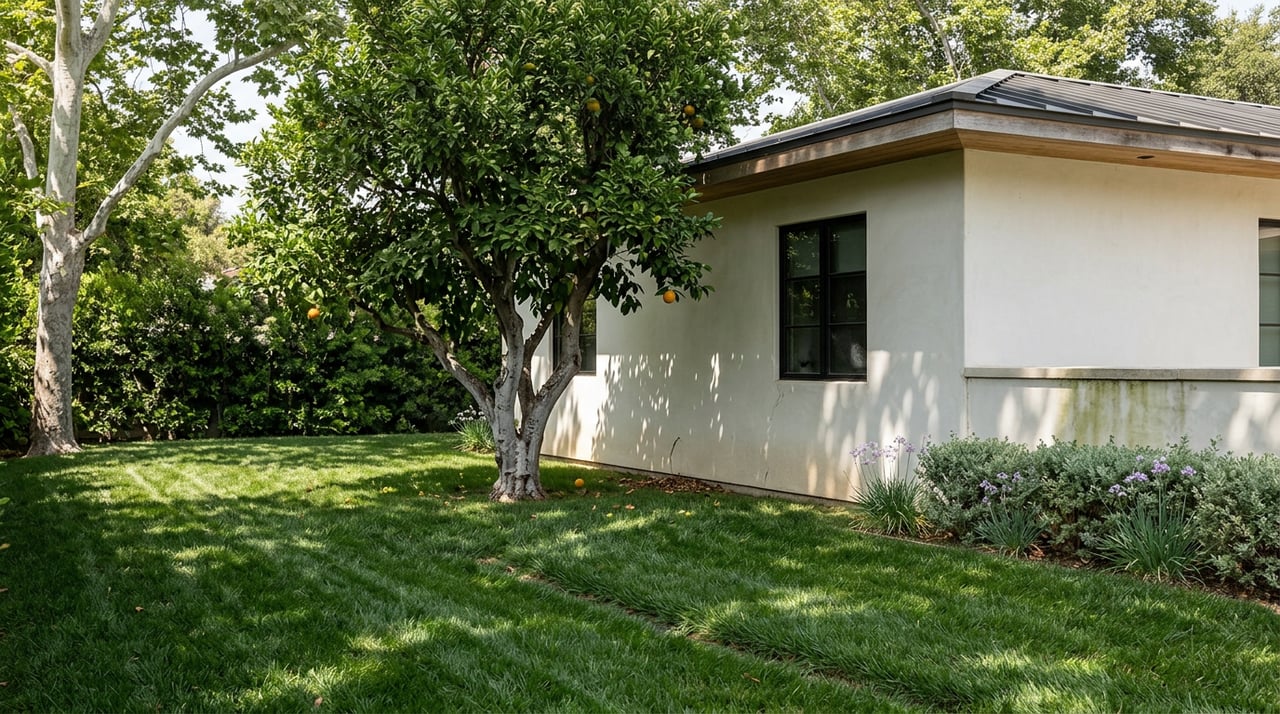
Walk two blocks in Arcadia Proper and you'll find ranch houses built in the same decade, on lots of similar size, priced far enough apart that the gap can't be explained by the kitchen or the roofline. The house itself often isn't the reason. The reason is usually a line on a parcel map that most buyers never think to ask about: whether that specific lot carries active flood irrigation rights through the Salt River Project.
That line is one factor in Arcadia real estate, though it may not be obvious during a showing. Buyers walk the lawn, admire the citrus canopy, and assume the price reflects the house. It doesn't, not entirely. A meaningful share of what separates one Arcadia parcel from its neighbor is a bundle of fixed rights and boundary assignments attached to the dirt, not the drywall. Understanding that bundle is the difference between reading the median price correctly and getting outbid by someone who did their homework on a specific parcel instead of the neighborhood average.
The Asset That Isn't on the Appraisal
Arcadia's lawns exist because of infrastructure nobody driving by can see. SRP delivers canal water through 131 miles of main canals and roughly 1,000 miles of neighborhood laterals and ditches, moved by employees called zanjeros, a Spanish term for ditch rider, who open delivery gates and route water to the highest point of a block. From there, the responsibility flips. Getting water from that delivery gate to your actual lawn, and keeping the on-site ditches, valves, and drainage working, is the homeowner's job, not SRP's.
That handoff is an important part of understanding flood irrigation. SRP explains that flood irrigation rights are parcel specific. They don't attach to a neighborhood, a ZIP code, or even a whole street. A house two doors from a fully irrigated lot can have no active delivery at all if a prior owner let the connection lapse or a subdivision split severed it. The lush lawn on the tour says nothing about the parcel you're actually bidding on until someone confirms the account is live.
What a Delivery Actually Costs You
In dollars, flood irrigation is close to nothing. Owners typically pay a modest annual fee to the Salt River Valley Water Users Association for a lot that would cost far more to keep green on a metered sprinkler system. The annual fee is one part of the cost of flood irrigation.
Another cost is the time and attention it can require. Someone has to be home, or arrange for a landscaper, on the scheduled delivery day, sometimes at an inconvenient hour, because missing a turn can mean waiting weeks for the next one. Multiple properties on a block often share a single turnout and coordinate who opens and closes the gate. Standing water needs drainage or it becomes a mosquito problem. None of this shows up in a comps sheet. All of it shows up in year one of ownership.
Why Cash Buyers Are Chasing the Same Lots
This is where the fixed-asset framing starts to explain market behavior instead of just describing scenery. As of July 2026, cash buyers made up roughly a third of Arcadia transactions, and that share climbed above half once price points crossed $3 million. That's not a coincidence of buyer wealth. It's a bidding pattern that shows up when a resource is fixed in supply and cannot be manufactured elsewhere in the city.
You cannot build new flood irrigation rights on a lot that never had them. SRP's canal infrastructure was laid out generations ago on top of Arcadia's old citrus groves, and new construction anywhere else in Phoenix simply doesn't have access to it. So when an original-condition, irrigated lot comes to market, it isn't competing against every house in the Valley. It's competing against a small, fixed pool of buildable parcels that carry a right nobody can replicate, which is why those lots tend to sell fast and why builders active in the neighborhood, including names like Carmel Homes, Cullum Homes, Sever Custom Homes, Bedbrock Developers, Calvis Wyant Luxury Homes, and Thomas James Homes, compete aggressively for them. A teardown-to-certificate-of-occupancy rebuild in Arcadia typically runs 12 to 24 months, which means a builder's bid on a raw lot is really a bid on a two-year pipeline, priced today against a resource that will never get more abundant.
Same ZIP Code, Very Different Deal
The spread between two Arcadia parcels usually comes down to a handful of factors that don't show up in a median price headline.
| What's attached to the parcel | Legacy irrigated lot | Lot without active irrigation rights |
|---|---|---|
| Water source for landscaping | SRP canal delivery through SRVWUA | Metered city water only |
| Builder and cash-buyer interest | High, especially for teardown potential | Lower, treated more like standard resale |
| Ongoing responsibility | Scheduled delivery coordination, drainage upkeep | Standard sprinkler maintenance |
| Price behavior | Tends to move fast, priced at a premium | Prices closer to citywide comparables |
None of this means a non-irrigated lot in Arcadia Lite is a lesser buy. It means the price isn't measuring the same thing, and comparing two Arcadia listings by price per square foot alone will mislead you if one carries the right and the other doesn't.
The Rules With No Rulebook
Arcadia is largely HOA free, which is part of its appeal to buyers tired of design review committees. But no HOA doesn't mean no restrictions.
If your plan involves a major addition or a future lot split, that's a document to read before you write an offer, not after you've already fallen for the mature pecan tree in the backyard.
A Boundary Line That Doesn't Show Up on the Listing Sheet
School district assignment in Arcadia is not uniform, and it can change from one side of a street to the other. Depending on the exact address, a parcel falls under Scottsdale Unified or under Madison Elementary and Phoenix Union, with the dividing line running near 56th Street. Two houses that look identical in every marketing photo can carry different district assignments, and that assignment is tied to the parcel, not to the Arcadia name on the listing.
Verify this independently for any specific address you're considering, since district boundaries are a matter of public record and not something a buyer should assume based on ZIP code or neighborhood reputation alone.
What This Means When You Write the Offer
Put the pieces together and the picture that emerges isn't just "irrigation makes lawns greener." It's a market where the price you're actually negotiating reflects a bundle of parcel-specific rights, several of them invisible on a walkthrough. Before you write an offer in Arcadia, ask the seller for recent SRP account documentation, request a copy of any recorded deed restrictions, and confirm school assignment for the specific parcel rather than the general area. Those three checks tell you more about what you're actually paying for than the comparable sale two doors down ever will.
FAQ
Does every Arcadia home have flood irrigation rights? No. Rights are parcel specific, and some Arcadia lots were never connected or had their delivery decommissioned over time. Confirm active status and transferability for any specific address before assuming the lush landscaping came from the canal system rather than a sprinkler bill.
Can a homeowner switch from flood irrigation to a standard sprinkler system? Some owners do convert, but it typically involves excavation, backflow prevention, and coordination with SRP and the City of Phoenix, plus applicable permits. It's a project to price out in advance, not a weekend swap.
Does flood irrigation affect insurance or financing? Flood irrigation is a landscaping delivery system using non-potable canal water, not a floodplain designation, so it's a separate question from FEMA flood zone status. Lenders and insurers will still evaluate standard property condition factors independent of irrigation rights.
If you're weighing two Arcadia parcels and the price gap doesn't line up with what you're seeing on the tour, that gap is usually explainable, just not from the street. The Taege Team can pull the SRP account history, deed restrictions, and school assignment on a specific address before you write an offer, so the number you're negotiating against reflects what's actually attached to the lot. Request a free home valuation and we'll walk the parcel-level details with you.
This article is general information, not legal, tax or financial advice. Consult a qualified professional about your situation.