

If you’re planning to buy a home this year, there’s one expense you can’t afford to overlook: closing costs.
Most buyers know they exist, but fewer truly understand what they cover—or how much they can vary depending on where you’re buying. Let’s break them down.
What Are Closing Costs?
Closing costs are the additional fees and payments you make when finalizing your home purchase. Every buyer pays them.
According to Freddie Mac, these often include:
-
Homeowner’s insurance
-
Title insurance
-
Loan application fees
-
Credit report fees
-
Loan origination fees
-
Home appraisal and inspection
-
Property survey
-
Attorney fees
These costs are due at settlement and are separate from your down payment.
National vs. Local: Why Closing Costs Vary
You’ll often hear that closing costs run between 2% and 5% of the home’s purchase price. While that’s a good starting point for budgeting, it doesn’t tell the whole story.
Closing costs can differ dramatically based on:
-
Taxes and fees where you live (transfer taxes, recording fees, etc.)
-
Local service costs (title, attorney, appraisal)
-
State laws and regulations that impact what’s required
That’s why a buyer in one state might spend just a few thousand dollars while another could face a bill closer to $10K—or more.
A State-by-State Look at Today’s Closing Costs
To give you a sense of the range, here’s a look at typical closing costs for the median-priced home in each state (see map below).
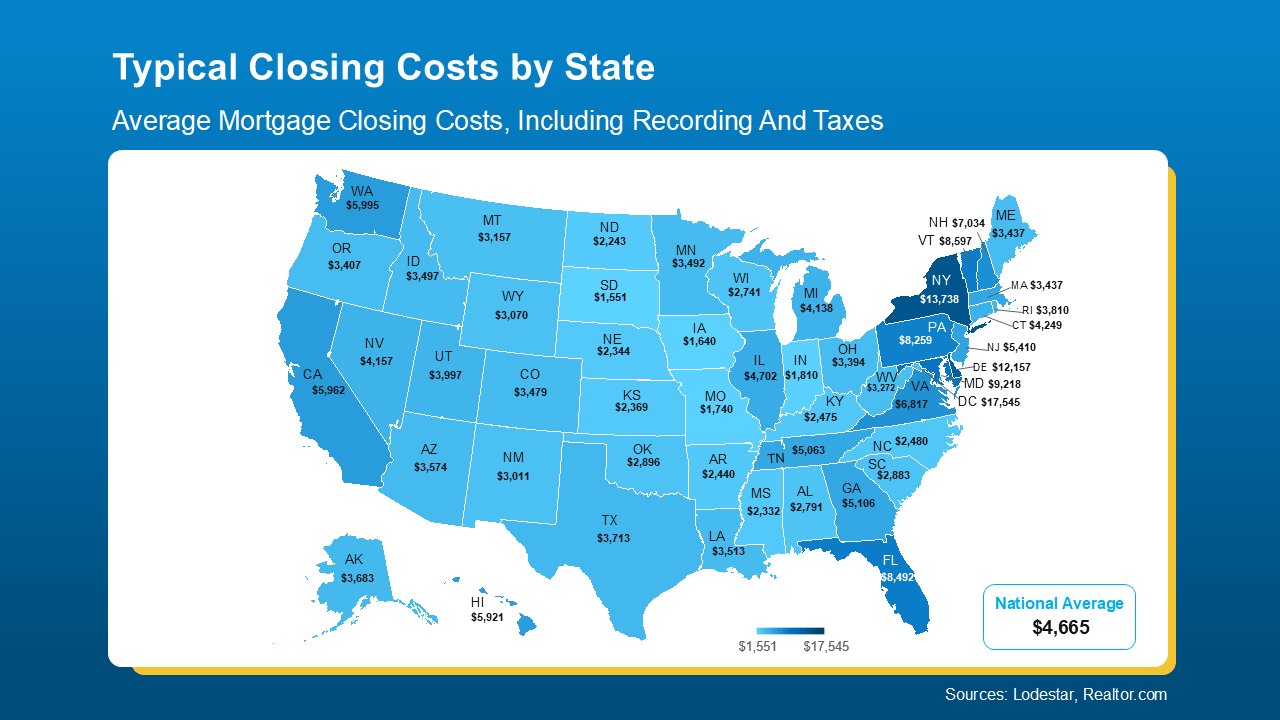
As you can see:
-
In some states, closing costs average between $1K–$3K.
-
In others, they can run closer to $10K–$15K.
That’s a huge swing—especially for first-time buyers.
How to Plan (and Save) on Closing Costs
If you want real numbers tailored to your budget, the best step is to talk to a local agent and lender. They can calculate based on your price range, loan type, and location.
In the meantime, here are a few proven strategies to help reduce your costs:
-
Negotiate with the seller: Ask for concessions or credits toward closing costs.
-
Shop around for homeowner’s insurance: Compare coverage and premiums.
-
Look into assistance programs: Some states, professions, and even neighborhoods offer help. Your agent and lender can guide you.
Bottom Line
Closing costs are an essential part of buying a home—but they’re not one-size-fits-all. Knowing what to expect (and how to potentially lower your bill) can give you confidence and clarity in the buying process.
Connect with a local agent or lender today to get a personalized estimate of closing costs in your area and create a budget that works for you.